
Why Middle-Market Firms Outgrow Small-Business BI Tools (3 Signs)
- Retail & eCommerce
- manufacturing-cpg
- SaaS & Tech
TL;DR
Mid-market companies typically hit a data infrastructure wall around $50M in revenue — not because BI tools failed, but because organizational complexity (product lines, sales channels, entities) outpaced them all at once. Three signs mark the transition: the best analyst spends most of their time (often 60% of the week) maintaining reports instead of analyzing data, Finance closes the books using a spreadsheet only one person understands, and decisions that should take hours take weeks because nobody trusts the numbers. Enterprise vendor proposals to fix this typically run $500K to $2M in year one; the actual fix is the underlying architecture pattern, not the platform price tag.
Key takeaway — Every mid-market company hits the same inflection point. The dashboards multiply, the spreadsheets become critical infrastructure, and decisions slow down because nobody trusts the numbers. This isn’t a technology problem — it’s a growth milestone that demands a different approach to data.
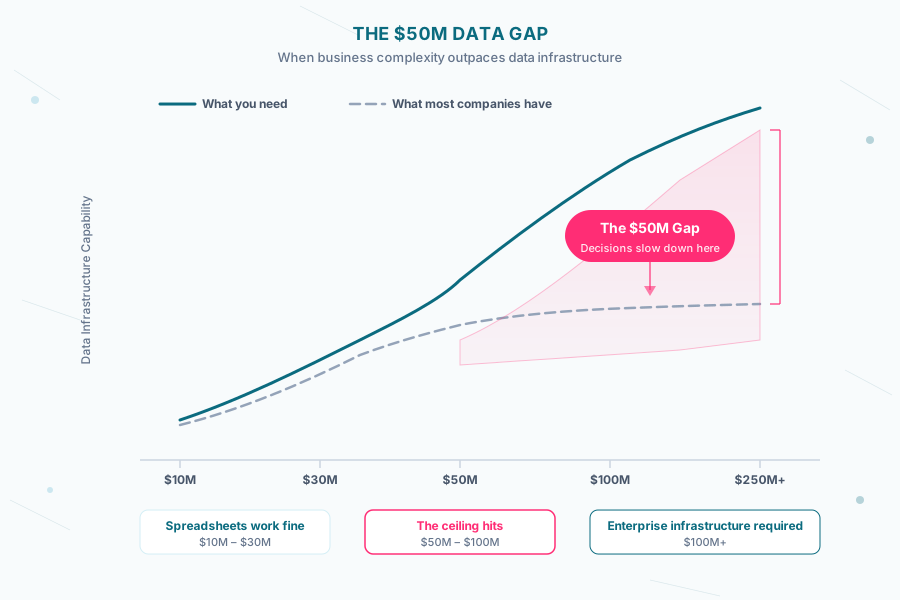
Every growing company hits the same wall. Around $50M in revenue, the tools that got you here start failing silently. Not crashing, not throwing errors — just quietly becoming the bottleneck nobody wants to name.
I’ve seen this pattern at every mid-market company I’ve worked with, across retail, manufacturing, SaaS, and professional services. The specifics change, but the shape of the problem is always the same.
The $50M wall
At $10M, a smart analyst with Excel can answer almost any question the business throws at them. At $20M, you add a BI tool — maybe Tableau, maybe Power BI, maybe Looker — and it works. Dashboards get built. People feel good. The CEO gets a weekly report with charts that go up and to the right.
At $50M, something shifts.
It’s not one thing that breaks. It’s that the organizational complexity outpaces the data infrastructure all at once. You went from one product line to four. From two sales channels to six. From domestic to international. From one entity to a holding structure with intercompany transactions that make your accountant’s eye twitch.
The BI tool didn’t change. Your business did.
A retail company I spoke with had 47 Tableau dashboards. Nobody trusted any of them. They all showed slightly different revenue numbers because each one was built at a different point in time, by a different analyst, pulling from a different extract. The CEO’s Monday morning number came from a spreadsheet that a senior analyst manually updated every Sunday night.
A manufacturing company had invested heavily in Power BI. Beautiful dashboards. But when the CFO asked why margins were declining in one product category, it took three weeks to get an answer — because the data lived in four systems and nobody had built the joins. The dashboard showed what was happening. It couldn’t tell them why.
A SaaS company with strong growth had a “single source of truth” that was actually three sources stitched together with a Python script that ran on one engineer’s laptop. When that engineer went on vacation, the executive dashboard went dark for two weeks. Nobody noticed for three days.
These aren’t technology failures. They’re symptoms of a company that grew faster than its data infrastructure.
Three signs you’ve outgrown your tools
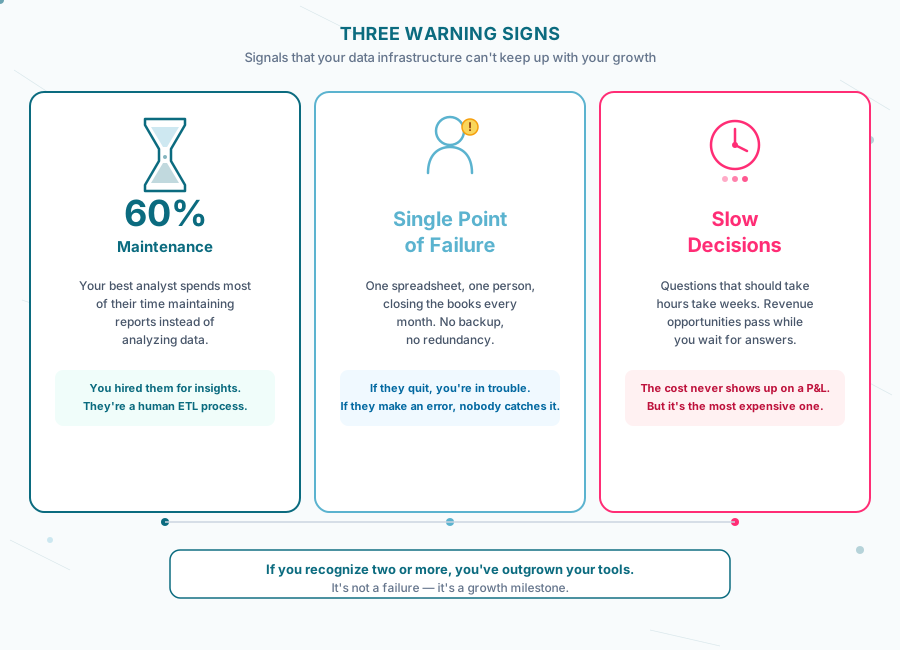
I’ve learned to look for three specific signals. They show up in almost every company between $50M and $150M, regardless of industry.
Your best analyst spends most of their time maintaining reports instead of analyzing data. This is the most expensive version of the problem. You hired someone smart — maybe you’re paying them $140K — and they spend 60% of their week updating dashboards, fixing broken data pipelines, and answering ad hoc requests by exporting CSVs. They were hired to find insights. Instead, they’re a human ETL process. They know it. You know it. Nobody talks about it.
Finance closes the books using a spreadsheet that only one person understands. Every mid-market company has this file. It’s usually called something like “Master Revenue Reconciliation v14 FINAL (2) - Copy.xlsx.” It has macros. It has hidden tabs. It has a formula that references a cell on another tab that references a named range that was defined three years ago by someone who left the company. The person who maintains it lives in quiet terror that they’ll make an error. The CFO lives in quiet terror that this person will quit.
Decisions that should take hours take weeks because the data isn’t trusted. This is the one that costs real money. Not the BI license. Not the analyst salary. The cost of slow decisions. When a VP needs to commit to a pricing change, or a COO needs to decide whether to open a new facility, or a CFO needs to forecast cash flow for a board meeting — and the answer is “we’ll need a few weeks to pull that together” — that delay has a price. It’s just one that never shows up on a P&L.
If you recognized your company in any of those three, you’re not alone. You’re just at the stage where what got you here cannot get you where you’re going.
What the enterprise vendors won’t tell you
Once you realize you’ve outgrown your tools, the obvious move is to look at what the big companies use. That’s when the enterprise vendors show up.
They’ll show you a demo. It’ll look incredible. They’ll talk about “unified data platforms” and “AI-powered insights” and “single pane of glass.” The proposal will land somewhere between $500K and $2M for the first year, plus implementation, plus training, plus the consulting partner they recommend (who happens to be the only firm certified to implement their product).
What they won’t tell you is that most mid-market companies don’t need the platform. They need the architecture patterns that the platform imposes — clean data models, governed definitions, automated pipelines, trustworthy metrics. You can build that with modern open-source and cloud-native tools at a fraction of the cost.
What they also won’t tell you is that the technology is the easy part. The hard part is the consulting model.
Big firms send you a team. A partner shows up for the sales meeting. A manager shows up for kickoff. Then you get three junior consultants who are learning on your dime, billing $300/hour, and producing documentation that nobody reads. The partner reappears for the final presentation. Twelve months later, you have a strategy deck and a system that your team can’t maintain without ongoing support — which, conveniently, the same firm is happy to provide.
Small firms and freelancers give you the opposite problem. You get a senior person who knows what they’re doing, but they don’t have the breadth. They can build your dashboards but can’t design your data model. They can write SQL but can’t advise on organizational change. They solve the immediate problem and leave you with a new set of dependencies.
The gap in the market — and I’m biased here, because it’s exactly the gap Clarivant was built to fill — is senior practitioners who bring enterprise-grade thinking without the enterprise delivery model. People who build the thing and transfer the knowledge, so that when they leave, your team is more capable than when they arrived. Not more dependent.
The question to ask
There’s one question that cuts through all of this. I ask it in every initial conversation, and the answer tells me everything I need to know:
Are you making decisions with data you trust?
If the answer requires caveats — “mostly,” “for some metrics,” “it depends on who pulled the report” — you’ve outgrown your tools. Not because the tools are bad. Because your business became more complex than they were designed to handle.
That’s not a failure. It’s a milestone.
Frequently asked questions
Why do middle-market firms outgrow small-business analytics tools?
Three forces hit at once around $50M in revenue: data volume crosses what spreadsheet-tier tools handle reliably, the org adds enough teams that a single source of truth becomes table stakes, and finance-grade reporting requires lineage and version control that small-business BI doesn’t enforce. The tools didn’t get worse — the business outgrew their assumptions.
What are the signs a mid-market company has outgrown its BI tools?
Three concrete signs: one analyst becomes a single point of failure for every report, decisions slow down because numbers from different dashboards disagree, and maintenance burden eats more time than building new analytics. If two of three are true, the stack is the bottleneck.
Is it the technology that fails, or the way the business uses it?
Neither — it’s that the tool was designed for a smaller operating reality. Small-business BI assumes one analyst, one source system, and ad-hoc reporting. Mid-market reality is multiple sources, cross-team consumers, and audit-grade rigor. The mismatch surfaces as silent reporting drift before it surfaces as a public outage.
What does mid-market-ready analytics infrastructure look like?
A managed warehouse (Snowflake, BigQuery, Databricks), a transformation layer with version control and tests (dbt or equivalent), a BI tool with a semantic layer (Sigma, Looker, Lightdash), and CI/CD for the data pipeline. The stack is bigger, but the operational discipline is what scales — not just the software.
When should a mid-market company start the migration?
Before the analyst becomes irreplaceable. Most companies wait until reporting fails publicly — by then, the migration runs under deadline pressure with the same overworked team. The right window is when revenue crosses $50M and trajectory is up, not when the stack finally collapses.