
When Finance Has to Ask Engineering: Sigma + dbt Write-Back
- Finance, Fintech & Investment
- SaaS & Tech
TL;DR
For five years, a cloud security company's Finance team filed a support ticket with Engineering every time they needed to change a pricing rate, because pricing lived as literal numbers inside the engineering codebase since 2021. Pulling those rates out into a flat table exposed a 118% undocumented price increase that had been silently running in production since 2025. The fix moved pricing into Sigma, the dashboarding tool Finance already used, with dropdown-validated fields so invalid entries are impossible to enter rather than merely rejected — the first Finance-led rate update took three minutes, with no ticket, PR, or deployment.
Key takeaway — For five years, Finance filed a ticket every time they needed to change a pricing rate. Engineering handled it when they could. When we migrated this cloud security platform’s revenue analytics, we pulled pricing out of the codebase, flattened it into a table, and gave Finance a Sigma interface to manage it directly. Along the way, we found a 118% undocumented price increase that had been silently running in production.
The story of how we moved pricing out of code and into the hands of the people who own it.
Every quarter, Finance needed to update a pricing rate.
Every quarter, they filed a ticket with Engineering.
Every quarter, Engineering got to it when they could.
This is the story of how that stopped — and what we found before it did.
We were brought in to migrate a cloud security platform’s revenue analytics to a modern stack. A few weeks in, we started pulling apart how pricing actually worked.
Pricing had been living inside the engineering codebase since 2021. Not in a spreadsheet. Not in a table anyone could open. In code — files with rates written as literal numbers, managed by engineers, deployed like software.
Five years of pricing changes had accumulated there. Each one was a review, a merge, a production run. Finance filed tickets. Engineering handled them when it could.
Finance had been asking for permission to change their own numbers for five years.
When we pulled all those rates out of the code and laid them flat, something became visible that hadn’t been before: a 118% undocumented price increase, silently running in production since 2025 — one of 15 silent bugs we found during the migration.
That’s what five years of pricing changes in code produces: a history nobody can read.
Pricing is data. It was being stored as code.
Data should be editable by the people who own it. Code should be managed by engineers. When you store pricing as code, Finance loses the ability to manage their own numbers — not because they can’t be trusted, but because the system was never built for them to touch it.
Engineers become involuntary gatekeepers. Finance becomes dependent on someone else’s sprint cycle to do work that’s fundamentally theirs.
How to know if you have this problem
The signals are usually the same:
- Finance files a ticket to change a single rate. Even a small one. Even one they’ve changed before.
- Pricing lives in
.sqlfiles or Jinja macros — not a table, not a spreadsheet, in code. - The only way to understand rate history is to read
git blame. - There’s a number somewhere in production nobody on the current team can explain.
- A pricing change requires a PR, a review, and a deploy before it’s live.
If two or three of those are true, your pricing is almost certainly in the wrong place.
The first step was moving every rate into a table.
One row per rate. One column for the effective date. The full history that had been scattered across years of code changes was suddenly visible in a single place — five years of rate changes, in order, readable by anyone.
Adding a new rate meant adding a row. Old rates stayed in place. The system always knew what rate applied on any given date. No coordination required, no risk of losing history.
Finance could now edit the table. But they still needed database access to do it — which meant they still needed engineering.
So we took one more step.
We moved the pricing tables into Sigma, the dashboarding tool Finance already used every day. Updating a rate meant opening a familiar interface, picking from a dropdown, typing a number, saving. Same system they used for reports. Same login. Nothing new to learn.
The dropdowns mattered more than the interface did. Without them, a typo in a product name or region code would break revenue calculations silently — wrong output, no error, no warning. The dropdowns constrained every field to valid values. Finance could only enter things the model already understood.
That’s what made self-service actually safe: not trusting that the right values would be entered, but making wrong values impossible to enter.
The stack was Snowflake for the data warehouse, dbt for the transformation layer, and Sigma for the Finance-facing interface — but the pattern works anywhere Finance has a tool that can write directly to your warehouse.
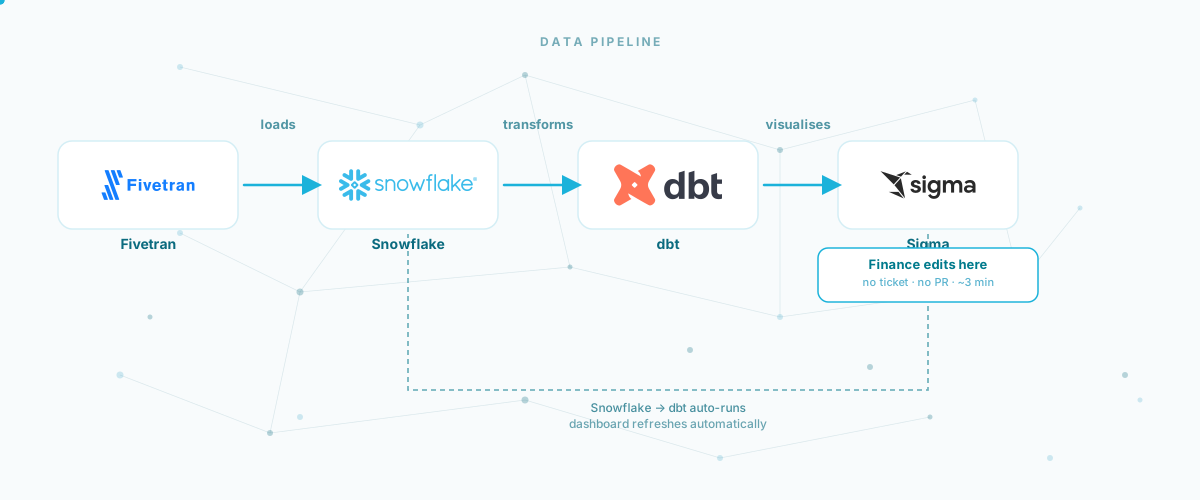
The first time Finance updated a rate themselves, it took three minutes.
No ticket. No waiting. No conversation about sprint priorities.
They picked the product. Entered the rate. Set the effective date. Saved. Ran the validation query from the guide we left them. Closed the tab.
When this pattern doesn’t apply
Not every pricing change belongs in a table. The distinction that matters: is this a rate update, or does it change how the model computes?
Rate updates — a new price, a changed multiplier, a revised discount — are data. They belong in a table Finance can edit. The model logic stays the same; only the inputs change.
Structural changes are different. A new product line that introduces a pricing dimension that didn’t exist before. A new billing model that requires new transformation logic. A regional expansion that changes how tiers are calculated, not just what the rates are. Those still belong in engineering — because you’re not updating a value, you’re changing how the system works.
The test: if a wrong entry in the table would produce a bad number but the model would still run, that’s data. If a wrong entry could break the model or produce nonsense silently, that’s engineering territory.
Most day-to-day pricing changes pass the first test. The ones that don’t will be obvious.
Frequently asked questions
Do I need Sigma specifically, or will any BI tool work?
You need a BI tool that can write back to your warehouse — not just read from it. Sigma has this built in for Snowflake. Other tools in this space (Omni, some configurations of Looker) support it too. The specific tool matters less than the capability: Finance needs to be able to save a value directly to a table your dbt models can read. If your current BI tool can’t do that, you’ll need either a different tool or a lightweight form layer on top of your warehouse.
What about audit trails? How do we know who changed what?
This is where the temporal pattern pays off. Because each rate row has an effective date rather than overwriting the previous value, the full history is always in the table. You know every rate that was ever active and when. For compliance purposes, you can layer warehouse-level audit logging on top — Snowflake’s query history, for example, captures who ran which write at what time. The result is more traceable than code ever was: git blame requires reading diffs; a table with effective dates is just a query.
What if Finance makes a mistake?
The same way any data mistake gets caught: validation. We built a validation query Finance runs after every update — it checks that the new rate is within expected bounds, that the product and region codes are valid, and that the effective date doesn’t conflict with existing rows. The dropdowns eliminate the most common error class (invalid foreign keys). The validation query catches anything else before it reaches production reporting. No system eliminates human error entirely; this one makes errors visible immediately rather than letting them run quietly for years.
How long does it take to implement self-service pricing?
The core infrastructure — dbt seeds, dimension tables, and Sigma input table configuration — took about two weeks in our engagement. The first pricing rate was editable by Finance within three days of starting. The remaining time was spent expanding coverage across all product lines and validating parity with the legacy system.
Does this approach work without Sigma?
The pattern is tool-agnostic. Sigma’s input tables provide the write-back UI, but any BI tool that can write to a database table works. The key is the dbt seed layer that validates inputs before they reach the data model. We’ve seen similar patterns with Streamlit forms and even Google Sheets connected to Snowflake via external tables.
What happens when a pricing rate needs to change?
Finance opens Sigma, selects the rate from a dropdown (populated by live dimension data — no free-text entry), enters the new value, and saves. The dbt seed picks up the change on the next run. The change is version-controlled, auditable, and reversible. No ticket, no PR, no deployment.
How do you prevent invalid pricing entries?
Dropdown validation sourced from live dimension tables. Every selectable value — region, product, plan, account — comes from a dbt dimension model. If a value doesn’t exist in the pipeline, it doesn’t appear in the dropdown. Typos and invalid entries aren’t rejected with an error; they’re simply impossible to enter.
Ask yourself one question before you build something like this: who should own this data after you’re gone?
If the answer is a business team — Finance, RevOps, Sales Ops — it should live somewhere they can edit without needing help. If you’re fielding engineering tickets for routine value changes, the data is in the wrong place.
Not everything belongs in Finance’s hands. New product lines, new pricing structures, new regions — those change how the model computes. Those still belong in engineering.
But a rate increase? A discount adjustment? A new regional multiplier? That’s data. It should live in a table, owned by the people who decided it.
Finance looked at us like we’d performed a miracle. They hadn’t expected to be able to update pricing themselves. Nobody had told them it was possible.
We hadn’t performed a miracle. We’d just stopped storing their data in our code.
If you’re curious how the Sigma input tables connect to the dbt seed layer — including the dropdown validation and the query Finance runs after every update — that’s all in Self-Service Analytics for Finance Teams.
And if this is your situation right now, our Unified Data Foundations practice has done this migration before — pricing logic out of code, into infrastructure Finance can operate. It moves faster than you’d expect.
The complete migration — pricing extraction, Sigma input tables, and the audit trail — is in the Revenue Analytics Migration case study.
If your Finance team still files tickets to change a pricing rate, we can move that into their hands in weeks. Book a discovery call.