
Scope Growth Done Right: 377 Objects to 161 Models
- SaaS & Tech
TL;DR
A cloud security company hired us to migrate 377 legacy BI objects into dbt + Snowflake; five months later we'd delivered a 161-model platform across 7 domains — nearly 5x the original scope — without touching any previously validated deliverable. The growth came in three waves: December added validation depth to reach 0.002% variance, January added an FY27 pricing sprint delivered in 9 batches over 9 days, and February added four new product domains plus a Streamlit semantic-query app and Finance self-service tooling. The mechanism that made this safe was domain isolation — no model in one domain could reference another — so each expansion was additive, never a rewrite.
Key takeaway — Scope grew 5x over five months on a cloud security analytics engagement. Not because of poor planning — because we built architecture designed to support it. The framework we’d use again: when to say yes, when to say no, and why domain isolation is the mechanism that makes scope growth safe.
We were hired to migrate 377 legacy BI objects. We ended up delivering a 161-model analytics platform across 7 domains. Scope grew by nearly 5x over five months.
That’s not a cautionary tale. It’s what good architecture looks like from the outside.
Every project management article on the internet is about scope creep prevention. Nobody writes the case for when scope growth is actually the right outcome — because the original infrastructure was built to support it. We just finished one of those engagements. This is what it looked like, why we kept saying yes, and the framework we’d use to decide all over again.
What the original scope was
The engagement started in November 2025. A cloud security SaaS company needed to migrate legacy BI logic — 377 objects spread across a legacy BI system that had calcified over five years — into a modern dbt + Snowflake + Sigma stack.
The initial target was metering-based revenue analytics for one product line: usage data from 12 cloud regions, consolidated into billing models that Finance could trust. Everything inherited from the legacy system needed to land in dbt with validated parity against historical invoiced amounts.
That was it. One domain. One product. One team of direct stakeholders.
The dbt project structure we established looked like this:
models/
├── staging/
│   └── product_alpha/          # 12 regional metering views
├── intermediate/
│   └── product_alpha/          # deduplication, union, enrichment
└── marts/
    └── product_alpha/          # billing facts, ARR, dimensions
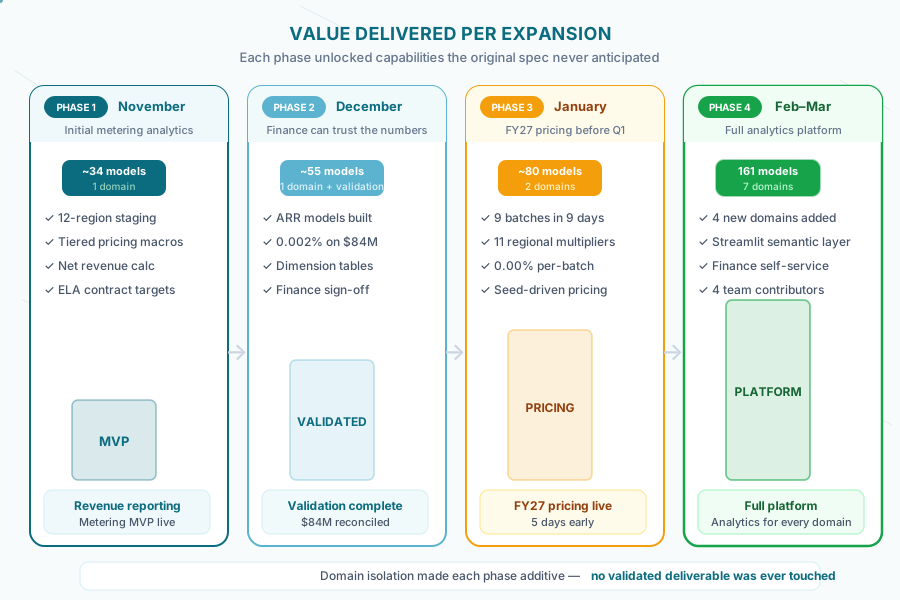
By the end of November, the MVP was running: tiered pricing macros, regional staging views, net revenue calculation, ELA targets. Two weeks from first commit to working fact tables.
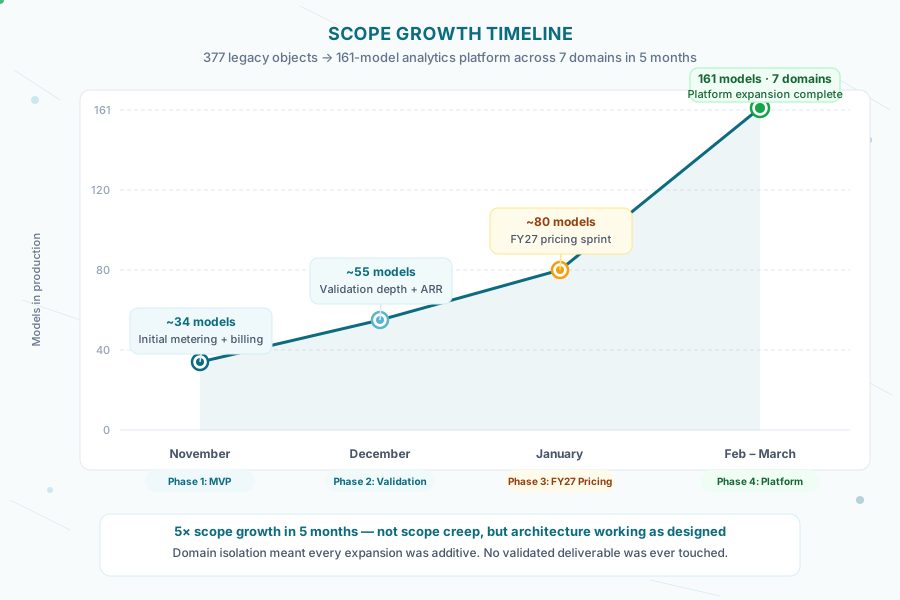
By the end of March, that project had grown to 161 models across 7 domains.
The expansions, one by one
December: Validation depth
The first expansion wasn’t new domains — it was depth. Proving parity to 0.002% variance across all historical revenue required more models than the original spec anticipated: ARR models, dimension tables, unpivoted fact tables formatted specifically for Sigma, archive patches to fill historical gaps.
This could be called scope creep. We’d call it working backward from the real requirement.
“We migrated the data” is not the same as “Finance can trust these numbers.” The additional modeling work was what closed that gap. Without it, the entire engagement would have ended with a technically complete migration that nobody was confident using.
The structural investment paid forward: the validation patterns we built in December — full outer join variance queries, grain-level debugging, parity-first sequencing — carried forward to every expansion that followed. When we got to FY27 pricing in January, we already had the validation infrastructure to run it at 0.00% per-batch variance.
January: FY27 pricing sprint
In January, the Finance team had a hard deadline: new fiscal year pricing needed to be live before Q1 bookings opened. New tier rates, 11 regional multipliers, a restructured discount hierarchy.
This was clearly outside the original migration scope. We said yes for two reasons.
First, the architecture supported it. The domain isolation pattern we’d established — each product domain in its own schema, no cross-domain dependencies — meant a new pricing model could live alongside existing revenue models without touching them. We didn’t have to refactor anything to add this.
# dbt_project.yml — domain isolation in practice
models:
  project_name:
    staging:
      product_alpha:
        +schema: slv_product_a
      pricing_fy27:
        +schema: slv_pricing_fy27
    marts:
      product_alpha:
        +schema: gld_product_a
      pricing_fy27:
        +schema: gld_pricing_fy27
Second, the Finance team’s ability to trust the new pricing models depended on them sitting next to the validated revenue models they’d just signed off on. You can’t validate FY27 pricing in isolation from the revenue data that the pricing was designed to generate. They had to coexist.
We delivered in 9 batches over 9 days. The story of how we ran that sprint is documented separately here. The short version: batch-based delivery with validation gates between each one, seed-driven pricing tables instead of hardcoded macros, and Finance in the QA loop from day one.
February: Platform expansion
February is where the scope story gets interesting.
The original engagement had one product domain. In February, the team asked whether the same infrastructure could support analytics for other product lines — other product lines with their own analytics needs, plus a front-end segment data source that had been running on its own reporting stack.
The ask was “can you look at whether this is feasible?” It turned out to be more than feasible. (We also spent two days figuring out that one of those product lines had a completely different metering schema than the others. That part didn’t make the pitch deck.)
Because we had established a clear pattern for domain isolation — staging models per domain, schema routing, no cross-contamination — adding new domains was additive, not invasive. Each new domain got its own schema tier and could be developed and deployed independently of everything already running.
models/
├── staging/
│   ├── product_alpha/
│   ├── product_beta/         # added Feb
│   ├── product_platform/     # added Feb
│   ├── product_agent/        # added Feb
│   └── product_gamma/        # added Feb
├── intermediate/
│   └── [mirrors staging structure]
└── marts/
    └── [mirrors staging structure]
This is exactly the scenario domain isolation is designed for. The existing domains kept running. New domains came online without a big-bang migration. The engineering team went from 1 contributor to 4, each owning a distinct domain, without stepping on each other.
We also added two capabilities that hadn’t been in the original scope: a Streamlit-in-Snowflake app for semantic querying (natural language against revenue data via Cortex Analyst), and a migration of the Sigma input table workflow so Finance could make pricing adjustments without engineering involvement.
Neither of these was in the original spec. Both emerged from the team understanding, after four months of working together, what was actually possible with the infrastructure they now had.
How we managed it operationally
Saying yes to scope growth is easy. Managing it without degrading existing deliverables is the hard part.
Three practices kept the project coherent through five months and 161 models across 7 domains.
Milestone tracking with explicit validation gates. Every phase ended with a formal validation milestone before we started the next one. December’s ARR validation milestone (“0.002% variance across all revenue data — complete”) was committed to the repo alongside the code that achieved it. January’s FY27 pricing milestone (“all 9 batches validated — complete”) was logged the same way. The history of the project is readable in the commit log.
# PLAN.md (excerpt, January milestone)

## FY27 Pricing Sprint

Status: COMPLETE ✓

Batches delivered:
- Batch 1-2: Seeds + core pricing macros ✓
- Batch 3-4: Regional multipliers + Snowflake JOIN+QUALIFY fix ✓
- Batch 5: Seed-driven v2 revenue models — validated 0.00% ✓
- Batch 6-7: Account discounts with Finance feedback ✓
- Batch 8: [blocked on partner data — skipped, completed with Batch 9] ✓
- Batch 9: ARR models with FY27 discounts — 265,638 rows, 0.00% variance ✓

Signed off by Finance: 2026-01-31
Domain isolation as a first-class constraint. We enforced a rule from week one: no model in domain A is allowed to ref() a model in domain B. Every mart is self-contained. Shared lookup data (fiscal calendar, regional metadata) lives in shared seed tables, not in another domain’s models.
This sounds like discipline for its own sake. It becomes a business continuity feature when the scope grows. When February’s expansion added four new domains, none of them required touching the existing billing models. The finance team’s dashboards kept running. The new domains developed in parallel.
Communicating scope changes as distinct work packages. When we agreed to the FY27 pricing sprint and the platform expansion, we explicitly framed each as a new work package — its own scope, timeline, acceptance criteria — not as an extension of the original project. This matters for two reasons. It gives the team clear milestones to celebrate. And it makes it easier to say “that’s a Phase 4 question” when something comes up during Phase 3, without it feeling like a rebuff.
When to say yes, when to say no
After five months of navigating this, here’s the framework we’d use again.
Say yes when the new work is architecturally additive. If you can add it without modifying what’s already running, the risk is low and the upside is high. New domains in an isolated multi-domain architecture are the clearest case. Say yes when the new work shares a validation dependency with existing work — the FY27 pricing models needed to sit next to the revenue models to be validated, so that’s not scope creep, that’s the natural shape of the problem. Say yes when the work was always latent in the scope: “migrating the data” implicitly required “Finance can trust the numbers,” which required more validation depth than the original estimate anticipated. And say yes when the client’s confidence in you is the driver. When a team asks for more because the first deliverable worked, that’s a different conversation than when scope grows because nobody had a clear spec to begin with.
Say no when the new work requires modifying validated deliverables. If adding a new domain means touching the billing models Finance signed off on, you’re taking on risk you can’t easily price. Protect what’s already validated. Say no when there’s no named owner — every expansion in this engagement had a specific stakeholder who would be using the output and signing off on the results. If nobody owns it, it doesn’t get properly scoped, validated, or handed off. Say no when the timeline is driving the scope rather than the scope driving the timeline — if the honest answer to “can you add this by end of month” is “only if we cut corners,” that’s the conversation that matters. And don’t expand at all before you’ve proven parity on what you already built.
The project that started as “migrate 377 legacy BI objects” ended as a revenue analytics platform running 161 models across 7 domains, with Finance self-service tooling, a semantic layer prototype, and a dev workflow that four engineers could use independently.
None of that was in the original spec. All of it was built on architecture that made it possible to say yes safely.
That’s the scope growth worth having.
Frequently asked questions
How much did the scope grow on this analytics engineering project?
The engagement started as a migration of 377 legacy BI objects into a modern dbt + Snowflake + Sigma stack for one product line. Over five months it grew to a 161-model platform spanning 7 domains — nearly 5x the original scope. The growth happened in three distinct waves: deeper validation work in December, an FY27 pricing sprint in January, and a four-domain platform expansion in February. None of it required reworking what had already been delivered and validated.
What is domain isolation and why does it matter for scope growth?
Domain isolation is an architectural rule that no model in one product domain is allowed to reference (ref()) a model in another domain — each mart is self-contained, and shared data like a fiscal calendar lives in shared seed tables, not inside another domain's models. It turns scope growth from a risk into a low-risk addition: when four new product domains were added in February, none of them required touching the already-validated billing models, so Finance's existing dashboards kept running while the new domains were built in parallel by additional engineers.
When should you say yes to scope growth mid-project?
Say yes when the new work is architecturally additive — it can be built without modifying anything already running. Say yes when it shares a genuine validation dependency with existing work, like new pricing models needing to sit next to already-validated revenue models to be checked against them. Say yes when the work was always implicit in the original ask — proving migrated data is trustworthy required more validation depth than the original estimate assumed. And say yes when a client asks for more specifically because the first deliverable already worked.
When should you say no to scope growth mid-project?
Say no when the new work requires modifying deliverables that are already validated and signed off — that risk can't be easily priced. Say no when there's no named stakeholder who will own and use the result; every expansion that worked in this engagement had a specific owner. Say no when the timeline is driving the scope rather than the other way around — if adding something by a deadline means cutting corners, that's the real conversation. And don't expand into new scope before you've proven parity on what's already built.
How did a Finance team get self-service pricing control out of a scope expansion that wasn't in the original plan?
During the February platform expansion, the team migrated the Sigma input table workflow so Finance could make pricing adjustments without engineering involvement — a capability that emerged only after four months of the team understanding what the underlying infrastructure could support. It wasn't in the original spec; it came from working relationship and platform maturity, not a requirements document.
How fast was the January FY27 pricing sprint delivered, and how did it avoid destabilizing existing models?
The FY27 pricing sprint — new tier rates, 11 regional multipliers, and a restructured discount hierarchy — was delivered in 9 batches over 9 days. It didn't destabilize existing revenue models because the domain isolation pattern let a new pricing model live in its own schema alongside validated revenue models without requiring any refactor of what already existed. Validation gates ran between every batch, with milestones logged directly in the project's tracking file and signed off by Finance.